Friday, September 16, 2011

Green Car's Big Adventure


Hi, my name is Green Car and I want to tell you about my big adventure in London and how it all came to be.  

I belong to a boy named Henry Stillerman.  Henry lives with his mother and daddy and sister Charlotte in a house on Alexander Street, in Statesville, NC.     

Henry likes cars.  He likes to play with them.  He likes to read about them.  He likes to collect them.  

Henry's parents and grandparents and sister and uncles and aunts and cousins and friends all know how much Henry likes cars.  They give him cars for his birthday and at Christmas and sometimes just to surprise him. 

Henry has many cars! I am one of Henry's cars.  Henry's favorite color is green. I am green and I am a car.  I guess that's why Henry likes me so much.  I guess that's why he let me go on the big adventure with his daddy. 

Henry's daddy was taking a trip to London.  He was going with Grandmommie to visit Uncle Bobby and to see all of the wonderful sights there. 

Henry's daddy was all packed and ready to go.  Before he left, he hugged and kissed Henry's mother and sister Charlotte, and Henry, and told them all that he would miss them so much and wished they could go along!  And then, he asked Henry:

"Can I take this little green car with me to remind me of you and keep me company?  I'll keep Green Car in my pocket, and everywhere we go, I'll take pictures with Green Car in them." 

"Okay, Daddy,"  Henry said.  "And you can take some more cars with you, too." 

Henry ran off to his room and got two more cars for his daddy.  Henry's daddy hugged Henry again and put all three of us cars in his pocket.  That's how the other green car and the white car got in the pictures that I will show you. 

Off I went on my big adventure, riding in Henry's daddy's pocket along with the other two cars, some change, and a set of keys. 

Let me tell you, it was a long trip.  It was pretty crowded in that pocket and it was dark too.  But when we finally got to London, Henry's daddy pulled me out and you would not believe the sights I saw!  

During the day, I would ride in his pocket from place to place where we would see all of the sights and take pictures of them. At night, I got to sit on top of the dresser beside the other two cars and a watch and a gold wedding ring. Every night, I would fall asleep to the sound of the cars and trucks and buses whizzing by outside, and the sound of Uncle Bobby and Henry's daddy snoring away in their beds.

Here are some of the pictures from my big adventure. 


This is the church where Uncle Bobby worked all summer.


Here we are at Trafalgar square.  You can see the big monument in the background.  On top is a Statue of Lord Nelson, a famous admiral in the Navy who won the important battle of Trafalgar. 


This is the fountain around the statue.  Many people like to come here to walk around and see the sights.  Can you see the big lion in the background?   He is one of 4 lions that guard the statue of Admiral Nelson.  He is so big that kids like to climb and play on him.  


We saw this restaurant called Henry's at Covent Square and just had to stop and get a picture. 


And another picture of Henry's Restaurant


Here I am on a bridge over the large river called the Thames.  Henry's daddy is holding me down so I won't blow away. 


And here we are on the Embankment of the river watching all of the boats go by. 


Here we are at the Tower of London.  It is down by the river.  The Tower of London is a very old building and has been used for many things:  A home for the queen, a place where the Queen's jewels are kept, and long ago it was a prison where people who did not agree with the king or queen were kept. 


A picture of my buddy, the other green car, with the Tower of London in the background


This is Buckingham Palace.  It is where the queen lives. It is surrounded by beautiful gates and protected at all times by the Queen's guards.  There are so many people walking around that it's hard to get a picture.  You can see the balcony where Prince William and Princess Kate came out with the royal family to wave at the crowd after they were married.  


This is the mall that leads from the Queen's house to a big arch.  Can you see all of the British flags that line the street?  The nick name for the British flag is "Union Jack."


This is the big arch called the Admiralty Arch.  It is on the other end of the Mall from Buckingham Palace.  When there is an important ceremony, the queen will ride in her golden carriage from her home at Buckingham Palace to the arch.  She will wave to the crowds along the way. 


This is Parliament, where the laws for England are made.  You can see the huge clock called "Big Ben."  It has been there for many years. 


This is a statue of Oliver Cromwell.  He was a famous leader who was liked by some and hated by others.  He did some good things for his country but was also very cruel. 


In this picture, we are on the train to Edinburgh. 


I'm at the top of Edinburgh Castle, looking out over the country below. 


A close up of me at Edinburgh Castle.  The roads here are made of cobblestone.  They are very bumpy.  With my new tires, I'd like to get out and take a spin.   


This picture was taken in a beautiful park at the bottom of the Royal Mile.  I'm parked on the ledge of a fountain, where lots of kids are wading.  I wish Henry were here.  He would love this place. 


Here I am up in the Highlands of Scotland, at a giant lake called Loch Ness.  It is cold and rainy, and they say there is a monster in the lake called "Nessie."  The water is so dark, I can't see a thing.  I'm kinda glad.  I'm not sure I want to see a monster in this place, so far away from home. 

I saved my favorite pictures until the end.  The grown ups went crazy over the buildings and statues, but I like things that can go, go, go. 


A red double decker bus  


A street sweeper, keeping the streets clean

On the last day, Henry's daddy packed the bags and put me back in his pocket for the long ride home.  I was so glad when we finally got back to Henry's house.  I was happy to see Henry and to get back to my home in the car case in Henry's room. I was glad to see all of the other cars, and the trains and the trucks and all of Henry's other toys. 

Henry's daddy was glad to be home too.  He was happy to see Henry's mother and Henry and little Charlotte.  He hugged and kissed them all and gave them presents he brought back from the trip. 

Henry's daddy showed Henry the pictures of my big adventure.  Henry said, "Daddy, why did you take my cars away?  I missed them." 

And Henry's daddy hugged him and answered, "I know, Henry.  Just like I missed Mama and Charlotte and YOU! It's always fun to go on a big adventure, but it's even better to get back home." 

And that is the story of my big adventure and of how it came to be. 


Thursday, September 15, 2011

Coming Full Circle

Our last stop before leaving London for the hotel near Gatwick Airport, where we would spend the night, in order to make an early flight home on Tuesday, August 16, was back at the British Museum where we started our sight seeing tour on the first day.

Robert had visited the museum several times and recorded much of what he saw in his blog. I, on the other hand, was jet lagged and tired from the flight over, and had difficulty taking in very much of the vast treasures that are stored there.  In the short time we were there, I did see the Rosetta Stone, but most of our time was spent walking around in the Great Court under its spectacular glass and steel dome. The dome is an architectural work of art in itself. Designed to cover Europe's largest public square (2 acres), it allows the sun to stream through its latticed surfaces, casting interesting geometric shadows on the white limestone walls and stairs of the Reading Room( where Karl Marx wrote Das Kapital) and creating an atmosphere of warmth and light throughout court.


Robert and I were drawn to this hands-on, history project created by families visiting the museum and participating in one of its many educational opportunities.  It was displayed in the Great Court. 


The artifacts from the ancient world in this museum are overwhelming.  Many were brought back during the height of British domination, when it is said that the sun never set on the British Empire.  There is so much of the ancient world collected and housed here that one has to wonder if there is anything of antiquity left to see in Greece or Egypt.  It was like the World Showcase at Epcot for the ancient world.  


These pictures from the Egyptian collection are dedicated to Mattie.  We have a date to visit Egypt when she gets a little older.  Until then, the pictures will have to do.  


Before we left the museum, we met Katarina and Willim for tea and a chance to say our final goodbyes.  The picture below is of Robert and Willim.  Bloomsbury Church is in the far background.   


Wednesday, September 14, 2011

Finding John Bunyan

Throughout our trip, we had been on the lookout for a statue of John Bunyan but had been unable to locate one. Bunyan (1628-1688), a Baptist forefather, is one of Bill's heroes for his stand on individual freedom as well as for the impact of Pilgrim's Progress on his (Bill's) thinking as a young seminarian introduced to the work for the first time, and the influence the book continued to have throughout his years as a pastor in the local church.  

Robert did a Google search and found that the major statue of Bunyan is in Bedford, near his birth place at Elstow and the crossroads where he first began to preach. He is buried in London, in the cemetery of Bunhill Fields, in the Burrough of Islington, north of the City of London, next to 3 other historically famous nonconformists: George Fox (1624-1691), Daniel Defoe (1659-1731), and William Blake (1757-1827). Both locations were too far away to visit in the time allotted. However, we discovered that there was a rather impressive statue located back over near Bloomsbury Church in the Holborn area, where Bunyan actually died, and we set out to find it.

Bunyan became ill in 1628, after he had ridden out from Bedford to London to mediate a conflict between a father and son over an inheritance issue. He found himself too weak to return home, and took refuge with a friend named John Strudwick, who lived in Holborn. He died there at Strudwick's house, away from his wife and family.

The statue is in a niche on the front of the old headquarters of the Baptist Union, built in 1901. The headquarters has since relocated to Oxfordshire and the building is no longer in use.


John Bunyan, holding a copy of Pilgrim's Progress. The sculptor is Richard Garbe, a late 20th century artist influenced by the Victorian and Edwardian eras. The work is dated 1953, but it is thought that this may be an error, and instead should be 1903, as the sculpture resembles the artist's earlier works that are more decidedly Victorian than his later work that were art deco. In addition, the sculpture is located near two others of Edward I and Edward VII, both done by Garbe in his early years and similar in style.


The opening lines of Pilgrim's Progress are printed below the statue


Friday, September 9, 2011

Tyng Up Loose Ends

In addition to our trip to Stratford-upon-Avon, Robert and I spent our last few days in London taking in the neighborhood around the Kensington Hotel where we were staying and revisiting a few sites of particular interest to us.

We enjoyed wandering around Hyde Park and then through Kensington Gardens, one of several enormous public parks in the area. It was fun to watch the families playing and relaxing together on the lawns--the adults sprawled out on blankets and the kids running around them with boundless energy, just like at home. 


Gold plated statue of Prince Albert at Hyde Park


Robert, with Prince Albert in the background


View across the lake at Kensington Gardens


The swans are fatter and healthier here at Kensington Gardens than at Stratford-upon-Avon


Again, the swans, dedicated to Bill


Lake at Kensington Gardens


View across the lawn of Kensington Palace


Walkway through Kensington Gardens

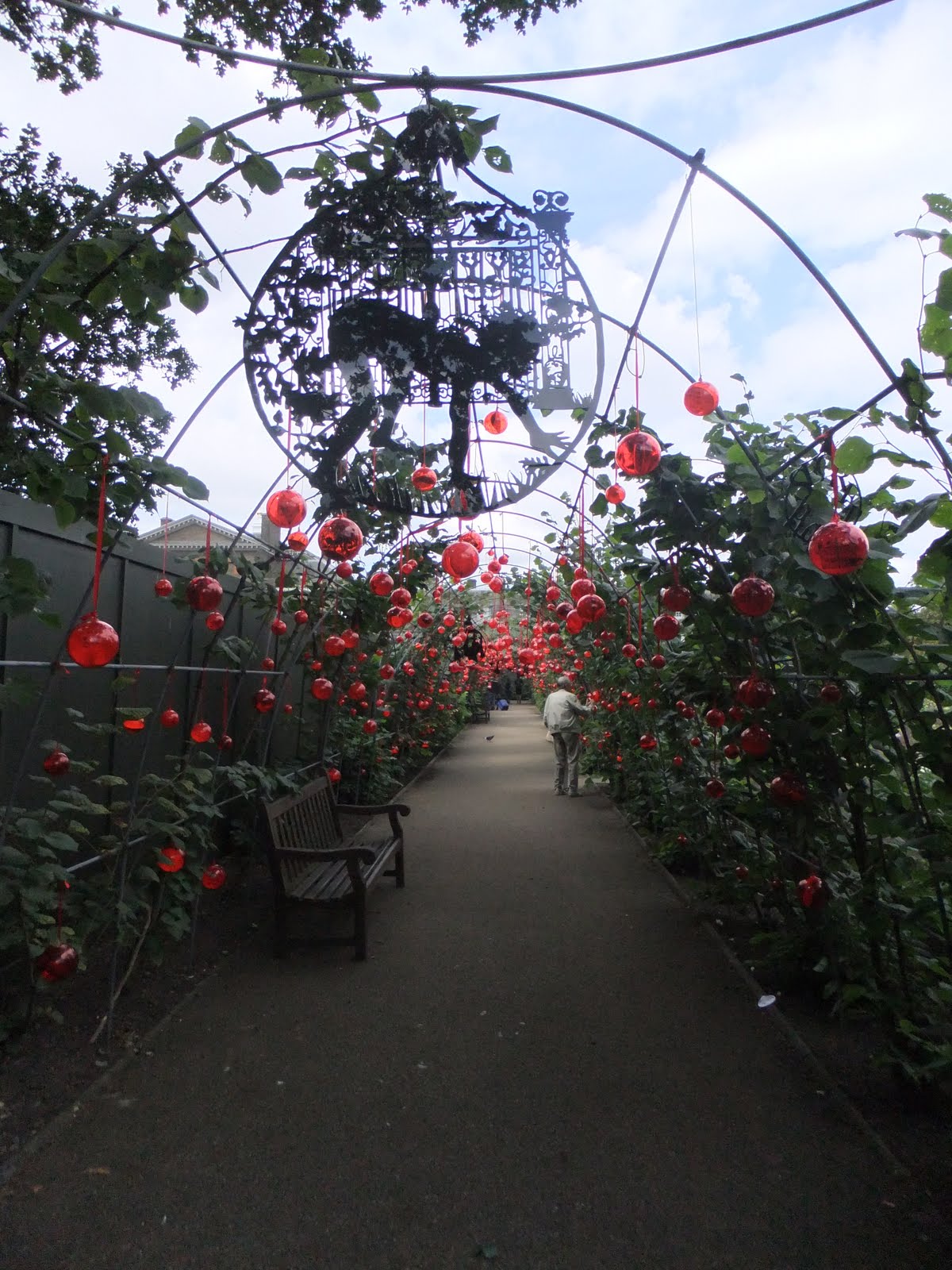
We took a quick tour of the grounds around Kensington Palace and decided to go inside after discovering the sunken garden pictured below, decorated with hundreds of shiny orange orbs of varying sizes. This turned out to be a project left over from the IN TRANSIT Arts Festival that had been on the grounds in July. It was conceived as an interactive activity for the public, in coordination with the Enchanted Palace exhibit, which is also an interactive, tactile experience for the public, who, as they tour the palace, must find  a set of clues in each of the rooms, that will reveal the secrets of the 7 princesses who lived at Kensington throughout its history.  

After completing the Enchanted Princess tour, visitors at the Arts Festival were invited to write their own secrets on paper and fold them inside the glass balls, to be hung throughout the sunken garden. They were left there for future visitors to enjoy and read.  I thought how fragile the glass balls were, and was impressed that they had been entrusted to public hands.  Just as I opened one and unfolded the paper revealing the secret, there came from behind me the sound of a bulb cracking like an egg on the gravel pathway. I turned just in time to see an embarrassed elderly gentleman drop a folded paper on top of the the shards of broken orange glass that were lying on the ground, and duck sheepishly out of the garden.  Secretly, I was relieved that it was not my globe that had fallen, and I replaced it carefully, and did not open any more of them. 

Wouldn't this make a wonderful fund raiser?


Tuesday, September 6, 2011

Winding Down

Harry flew out early Saturday morning, leaving Robert and me a little bit envious that we were not going home with him.  Robert was especially anxious to get back after being gone for 3 months, and I was a bit worn down by the pace we were keeping.  However, we decided to hang in there and give it our best shot for the the last three days. 

Robert was anxious for me to meet Margaret and Keith, the couple he roomed with for the second half of the summer in their flat near the Tower of London, as well as to touch base with them and thank them for their hospitality.  They were staying at their summer home at Stratford-Upon-Avon and had asked us to come out and have lunch with them while we were traveling. 

We decided go there on Sunday, August 13, and turned out making a full day of it.  The train took us to Birmingham, where we had to navigate our way across town from New Street Station to Moor Station to catch a connecting train.  We noticed a strong police presence as we deboarded, and guessed it was due to the earlier rioting that had broken out in the city.  As we made our way toward Moor Station, which was on the opposite end of the commercial district called the Bullring, we felt a bit unsure of ourselves and quickened our pace as we tried to take in the sites and snap a few pictures along the way.  At the only fork along the route, we went right when we should have gone left, and added about 30 minutes to our walk.  We finally made the connection and arrived at Stratford-upon- Avon, which is a quaint, picturesque Elizabethan village that gives one the feeling of travelling back 400 years in time. 

We shared a delightful lunch with Margaret and Keith, at Carluccio's, their favorite Italian restaurant located on the Avon River, in the shadow of the Shakespeare theater and Holy Trinity Church where Shakespeare is buried.  Keith works for the government and is in charge of the public charging stations for electrical cars that are a part of a large grant to reduce oil dependency and provide alternative energy sources in the UK.  Margaret is a retired educator who enjoys cooking and entertaining, and volunteering at the church.  Both of them are long time and devoted members of Bloomsbury Baptist Church, which they talked about with pride and great enthusiasm.  They also appeared to be extremely devoted to Robert, which immediately increased their stock with me. 

After lunch and farewells, Robert and I walked around the village before we headed back to catch the 5:00 p.m. train to London, chiding ourselves all the way that we did not get pictures with Margaret and Keith before we said our goodbyes. 

The trip back was much easier than the one going over.  We caught the express train this time and made the connection from Moor to New Street Station in less than 10 minutes.  On the ride out of Birmingham, we sat across from 3 young men who were obviously in a party mood.  One was dressed as Elvis Pressly, one as Pancho Villa, and the other was not wearing a discernible costume but was so full of himself that he did not need to. 

I stifled my curiosity as long as I could, and finally asked Pancho Villa why they were celebrating.  He explained that they had just been to a cricket match where England had beaten India to become the winners in what might be the equivalent of our World Series in baseball.  I congratulated them but was still confused about the significance of the Pancho Villa and Elvis costumes.  Were these mascots or something of the like?  "Oh, no," he replied.  "It's just a part of the festivity to dress up for these matches."  I settled back in my seat, and closed my eyes, exhausted from the day's travel.  Surrounded by the camaraderie and happy noise of fans rejoicing over their victory, I felt the warmth of familiarity and security.  Except for the fact that I was 3000 miles from home, I could easily have opened my eyes to find myself in the midst of a bunch of Braves or Panther fans celebrating a win. Cricket, baseball, football, whatever the sport:  team spirit is universal. 

We ended the day with dinner at a nice British restaurant, recommended by the concierge at the hotel.  Robert had invited Shelley Stillerman's brother John to join us, and it was wonderful to see  him again and to talk with someone connected to family and home.  John, an attorney with Wells Fargo, had arrived about the same Robert arrived at Bloomsbury, to work on a  six month project in the company's London office before returning to his home base in Charlotte.  We were chatting about the recent events in London and he told us about an eerie experience he had the previous week, while we were in Scotland. 

John's attention had pretty much been consumed  by the process of getting settled in his new surroundings, and he had not followed the news about the riots in detail.  One night, he worked extra late before he took the Tube back to his flat, which is above a restaurant across town from his office.  He was surprised to find that several of the Tube stops were temporarily closed due to nearby disturbances, and he had to take a detour from his usual route, which was still somewhat new to him.  As he crossed from the station into his neighborhood that was normally brightly lit and teeming with night life, he found the streets deserted and the store fronts dark and abandoned.  He hurried on to his flat and was relieved when he got there safely and without incident.  Later, he found out that the merchants had taken everything out of their display windows and shut their places of business down before dark, as a precaution against the looting and vandalism that had taken place in other neighborhoods.  It was a similar story to the one we heard from John, the volunteer at Bloomsbury several days earlier. 


The Selfriges Building in Birmingham--a most unusual piece of architecture which dominates the down town, or Bullring, as it is referred to by locals. 


The Swans at Stratford Upon Avon (dedicated to Bill, who wanted to make sure we saw them and took a picture)

Shakespeare Theater at Stratford Upon Avon

Holy Trinity Church where William Shakespeare is buried

Interior of  Holy Trinity Church


Grave of William Shakespeare


Kathy outside the church where Shakespeare is buried


Elizabethan town of Stratford-upon-Avon

Sunday, September 4, 2011

Kevin Spacey and Richard III


I've always been a fan of Kevin Spacey, and the minute I discovered that he would be performing in Shakespeare's Richard III at the Old Vic Theater during our stay in London, I ordered tickets for us to attend. I was so glad I did, because it turned out to be one of the hottest plays in London this summer and was completely sold out by the time we got there.

As our tickets were for the Thursday night, August 11 production, we checked into the Kensington Hotel on our return to London from Edinburgh, and got freshened up for an evening at the theater.  The Old Vic is located on the South Bank of the river, two blocks from Waterloo Station and the nearby Waterloo campus of Kings College, which houses the Florence Nightingale School of Nursing and Midwifery and parts of the Schools of Bio medicine and Dentistry. 

Allowing extra time for sight seeing along the way, we left early and caught the Tube to the Embankment so that we could cross the Waterloo Bridge to the South Bank on foot and take in a few more of the sights across the river before the play.  By walking, we misjudged the distance to the Old Vic and got a bit disoriented as to our location.  Several times, as we paused to study the map and figure out our next steps, a friendly passerby would stop and ask if we were lost and needed directions, assuring us that we were on the right course and would run into the Old Vic a little farther down the street. These friendly gestures of neighborliness were a welcome surprise and went a long way toward calming and reassuring our anxiety about being out and about in the wake of the riots.  We finally located the Old Vic, picked up our tickets, and still had time to grab a bite to eat before the production. 

The play was well worth the effort and one of the highlights of the trip.  Kevin Spacey gives a convincing performance as Richard III, who seeks by any means to eliminate all of his contenders to the throne of England, including his two nephews and a brother, standing in his way.  He is cast as a modern day dictator, akin to Muammar Gaddafi or Hosni Mubarak in his ruthless quest for power, and to the likes of Zimbabwe's Robert Mugabe and North Korea's Kim Jong-il, in his paranoia and dysfunctional personality unleashed on their unfortunate subjects. 

Spacey, the consummate villain, delivers his Shakespearean lines naturally and flawlessly, without British accent.  For 3 hours and 15 minutes, he is all over the stage, posture deformed by the weight of the hump on his back, toting a crutch, and strapped into a leg brace supporting his withered, pronated foot.  Through every inch of the performance, from the opening "Now is the winter of our discontent..." to the near closing lines in which he cries, "A horse,  A horse!  My kingdom for a horse!" he pours his energy into the role, as he connects with the audience and makes them co-conspirators of his nasty deeds and Machiavellian plots, revealing a multi faceted personality that is simultaneously evil, remorseful, cruel, charming, manic, and funny. 

Spacey maintains this momentum to the end, when Richmond's forces have won the battle of Bosworth Field, Richard is dead, and we see his lifeless body suspended by its heels from a rope and dangling above the battlefield, while Richmond is proclaimed victor and King of England, ultimately reining as Henry VII. Spacey hangs there motionless for a full two minutes as the play draws to conclusion. 

An interview with Kevin Spacey printed in the program, quotes him as saying that the play is "a physically and emotionally demanding role, one that requires dexterity with language, and commitment to giving 150%.  That's why I've stopped drinking, smoking, everything, to dedicate myself to this character."  No wonder! 

Friday, September 2, 2011

Back to London

We left Edinburgh in the rain, early Thursday morning,  and were delayed by an hour getting back to London due to flooding on the tracks.  The trains in the UK have a reputation for running on time and you would have thought that we had been delayed by days rather than minutes judging from the number of times the engineer came on the intercom to apologize for the inconvenience. 

Before checking into our hotel in Kensington, we stopped by Bloomsbury to pick up some baggage that we had stored in Andrea's office to lighten our load on the Scotland trip. John, one of the volunteers at the desk, updated us on the status of the riots that had broken out on August 6, in Tottenham, a northeastern neighborhood in London, after a peaceful protest of the death by police of a local man, Mark Duggan. While we were away, the looting and burning had spread in copy-cat fashion to other locations in London as well as the neighboring cities of Birmingham, Liverpool, Nottingham, and Bristol. The police appeared to be taken off guard at the magnitude and random nature of the violence, and they were indecisive and slow in putting a stop to it.

Prime Minister David Cameron and other MP's cut short their vacations and returned to London to deal with the crisis.  Tube stops near rioting neighborhoods were temporarily closed and the football match between England and Holland at Wembley was cancelled.  John said that on his street, the merchants removed merchandise from the display windows and boarded up their shops to prevent vandalism and looting  by the bands of disgruntled youths that were roaming neighborhoods and recklessly destroying property and striking out at innocent bystanders.

By Thursday, August 11, when we returned to London, the crisis had abated and everything appeared to be under control. The neighborhoods had been calm and without incident for several nights, due to increased police presence.  Scotland Yard had identified murder suspects and over a thousand people had been arrested in connection with the violence, looting, and robbery.  The House of Commons was engaged in spirited debate on long term solutions for addressing the social issues underlying the violence, and Bill Bratton, former New York and LA police chief, had been called in to consult with British law enforcement on gang violence and social unrest, a decision which gained mixed reviews  and a few raised eyebrows from the British press.

Most of the news coverage we managed to find in Edinburgh centered around the need for swift justice and accountability for the perpetrators of the senseless attacks on the innocent as well as the looting, and destruction of property.  Interviews of law officials, clergy, social workers, politicians, as well as citizens on the street denounced the violence as unacceptable acts of thuggery and brutality by bands of youth, undisciplined and out of control.  They called for increased security and protection across the city, and favored a zero tolerance approach, with severe consequences imposed on any individual involved in action resulting in the destruction of lives or property.

At the same time, there was a discernible sense of recognition among those interviewed, as well as  from the coverage on the debates from the floor of the Commons, that the implementation of a "Get Tough on Crime" approach could never address the root cause of the problem, which appears to reside in the anger of  a youthful underclass, unemployed and ineligible for university, with nothing but time on their hands to act out their frustration and disillusionment.  They seemed to concur that while looting and burning can never be tolerated by civilized society, neither can the repression and deprivation of basic human needs be ignored in the process of  protecting the resources of the privileged while ignoring the plight of the underprivileged. 

In the midst of our sightseeing and fun, 2500 miles away from home, came the jolting reminder of the widening gap that exists in our world between Haves and Have Nots, which has been accentuated by a weak global economy, war, and natural disaster. 

Competing with the story of the London riots that week, was the news of Standard and Poor's downgrade of the U.S. credit rating from AAA to AA-plus, sending the stock market into a tail spin.  Headlines across the UK read"US Humbled" and news analysts talked endlessly about what this might mean for the US economy and how this would affect the outcome of upcoming political contests between Democrats and Republicans.  Would Sarah Palin or Michelle Bachman succeed in ousting Mr. Obama?

It was not the ideal time to be travelling, in terms of dollar to pound exchange rate, and the news about the US economy was beginning to give me nightmares about what the trip would ultimately cost.  I was reassured when I called home to touch base with Bill.  He put everything in perspective for me with his classic response to my financial jitters:  "Don't worry," he said, "It's only money."